You still know every word to that song from the school bus in 2015. The cranial nerves? Not so much. We turn high-yield medicine into songs that get stuck the same way, so they're still playing in your head, rent-free, on exam day.
On the train, at the gym or between study sessions, your next lesson is one play button away. The lyrics and the lesson ride along, and the medicine sneaks in while you're humming.
Known side effectsHumming the Krebs cycle in the showerAnswering a question before the attending finishes itPassing
Get it stuck in your head♪Get it stuck in your head♪Get it stuck in your head♪
Get it stuck in your head♪Get it stuck in your head♪Get it stuck in your head♪
On purpose♫On purpose♫On purpose♫On purpose♫On purpose♫On purpose♫On purpose♫
On purpose♫On purpose♫On purpose♫On purpose♫On purpose♫On purpose♫On purpose♫
The earworm's story
Meet DJ Riddy.
The little worm with a big mission.
Every great song has a hook. Every medical student has something they just can't seem to remember.
Somewhere between the rhythms of Flatbush, Brooklyn, and a late-night medical study session, an unlikely DJ discovered that those two things might belong together.
This is the story of DJ Riddy, the earworm who decided that if a song was going to live in your head, it might as well teach you something.
CN I–XIIKrebs cycleCoag cascadeNephritic vs nephroticBeta-blockersBrachial plexus
Question 37
Sudden one-sided facial droop. Can't close the eye. Which cranial nerve?
CN VCN VII ✓CN XII
♪♫♬♪♫♪♬♪
Flatbush, BrooklynThe library · 2:07 a.m.Same night · 2:41 a.m.A few days later
01/ 04
4,012 cards due today♪Oh, Oh, Oh, To Touch And Feel…♪…And Feel: seven, facial ✓
Chapter 01 — The Hook
He could make you remember anything. Except the important stuff.
DJ Riddy had a gift. He could make a chorus follow you everywhere. On the subway. In the shower. During dinner. Even when you were trying to sleep.
Dancehall, hip-hop, old-school hits, commercial jingles—if it had a catchy hook, Riddy could make it stick.
But there was one problem. People remembered the songs. They forgot what they studied.
And Riddy couldn't help wondering: what if all that musical memory could be put to better use?
Chapter 02 — The Discovery
One student. Too many flashcards. Not enough time.
Late one night, Riddy found a medical student buried beneath a mountain of notes. Mechanisms. Pathways. Drug names. Diseases that sounded almost identical.
Hours of studying. Endless repetition. Another exam around the corner.
Then something caught his attention. The student couldn't remember a pathway they'd reviewed that afternoon. But when an old song started playing, they knew every word.
Years later. No flashcards. No studying. Just music.
Riddy adjusted his headphones. He had an idea.
Chapter 03 — The Remix
What if the lesson became the song?
Riddy went to work. He took the medical facts, found the patterns, and started building a beat around them.
A complicated sequence became a chorus. A difficult distinction became a memorable hook. And the material that once felt impossible to organize suddenly had a rhythm.
But Riddy discovered something else. Remembering the words wasn't enough. Students needed to understand what they meant.
So he paired the music with explanations, clinical context, and questions that tested whether the learning was actually sticking.
A little music. A little medicine. A whole new way to study. Medridmia was born.
Chapter 04 — The Recall
Now the song comes back when you need it.
A few days later, the student encounters a familiar question. Two clinical findings. One important distinction.
For a moment, the answer seems just out of reach. Then a melody comes to mind. A lyric helps bring back the concept. The explanation starts making sense again. And the student can work through the question.
That's what Riddy was looking for. Not a shortcut around understanding medicine. A different path back to what you've learned.
Today, DJ Riddy has one mission: to make medical learning a little more memorable, one track at a time.
The story continues
There will always be another song stuck in your head. Let's make the next one worth remembering.
Medridmia combines mnemonic songs with the tools you need to turn familiarity into knowledge.
Find your rhythm.
Search for a medical topic, browse by subject, or discover something new.
From pharmacology to physiology, find music built around the concepts you're studying.
Learn beyond the lyrics.
Listen while the lyrics follow along, then explore a clinical lesson explaining what the song is teaching.
Because knowing the chorus and understanding the diagnosis are two different things.
See what you remember.
Test yourself with questions and bring concepts back through spaced repetition.
Not yet? Try again. Got it? Keep going.
The goal isn't just to recognize the song. It's to recall the medicine.
The science behind Medridmia
Built around the science of memory.
Remember learning the alphabet through a song?
That same idea inspires Medridmia: transforming complex medical concepts into memorable music, then reinforcing what you've learned through clear explanations, active recall, and spaced repetition.
We believe learning medicine should be memorable—not just manageable.
ABCDEFG
Same melody as Twinkle, Twinkle. Twenty-six letters, still in order, decades later.
What the research shows
Music and memory
Studies that tested music itself
A systematic review of musical mnemonics, and a randomized experiment on learning by singing.
28/37studies in a systematic review
76% of studies reported a musical-memory benefit
28 of 37 studies reported a benefit on at least one memory outcome: a share of studies, not a size of effect
A systematic review of 37 musical-mnemonic studies found that 28 reported a benefit on at least one memory outcome. Results varied across experiments, but the findings support the potential of structured music as a memory aid.
Average score for producing spoken Hungarian phrases. 60 adults in three groups: speaking, rhythmic speaking and singing.
In a randomized experiment involving 60 adults learning an unfamiliar language, participants trained through singing performed significantly better on selected spoken-recall tasks than participants trained through ordinary or rhythmic speech.
Medical-education trials of pictures with audio, not songs
Two randomized trials of audiovisual mnemonic platforms. Neither tested songs on their own, and neither tested Medridmia. They show what memorable, structured material can do for medical students.
208%higher free recall at one month
Medical mnemonics can support long-term recall
1×Text only
3.1×Audiovisual mnemonics
Average free-recall score, one month after studying
In a randomized pilot involving 87 medical students, an audiovisual-mnemonic learning platform achieved 208% higher average free-recall scores than text-only study materials at one month.
This study tested a multimedia mnemonic platform rather than educational songs specifically, but it demonstrates the potential of memorable, structured learning experiences in medical education.
A sustained advantage in medical-student retention
Day 01 wk2 wk4 wk
Multiple-choice tests repeated four times; the mnemonic group scored significantly higher each time
In a separate randomized trial of 80 first-year medical students, the group that studied with story-based audiovisual mnemonics outscored the text-reading group on multiple-choice tests immediately and at one, two and four weeks, and recalled keywords faster. At four weeks the averages were 24.95 against 14.98, about 67% higher.
Explore medical concepts through original mnemonic songs that make key facts easier to associate with memorable melodies and rhythms.
See the words
Follow synchronized lyrics so you can connect what you're hearing with the terminology you're learning.
Understand the medicine
Move beyond memorization with explanations that clarify mechanisms, clinical context, and essential distinctions.
Test what you know
Reinforce learning through questions that challenge you to retrieve information without relying on the song.
Return before you forget
Use spaced repetition to revisit concepts over time and strengthen long-term retention.
From memorization to medical understanding
A memorable chorus might help you recall a drug's adverse effects. But recognizing those effects in a clinical vignette requires something more.
That's why Medridmia combines music with explanations and retrieval practice—bringing together memorable learning and the clinical knowledge that medical students need.
Medridmia combines the memorability of music with the science of active recall and spaced repetition—helping medical learners turn difficult concepts into knowledge they can revisit, practice, and apply.
Hear it. Learn it. Remember it.
Scientific transparency: the research referenced above involves musical mnemonics, language learning, and audiovisual educational interventions. These findings provide a scientific rationale for Medridmia's design but do not establish that Medridmia itself improves examination scores or long-term retention. Product-specific effectiveness requires direct evaluation. Percentages are relative differences between published group averages, not percentage points, and the medical-education trials cannot isolate the effect of music.
Inside the app
All the music. All the medicine. Your way.
The lesson behind the song
Every memorable hook deserves a meaningful explanation.
Explore the underlying clinical concepts through concise lessons and the Medridmia Knowledge Library.
Browse it like Spotify. Leave with a differential.
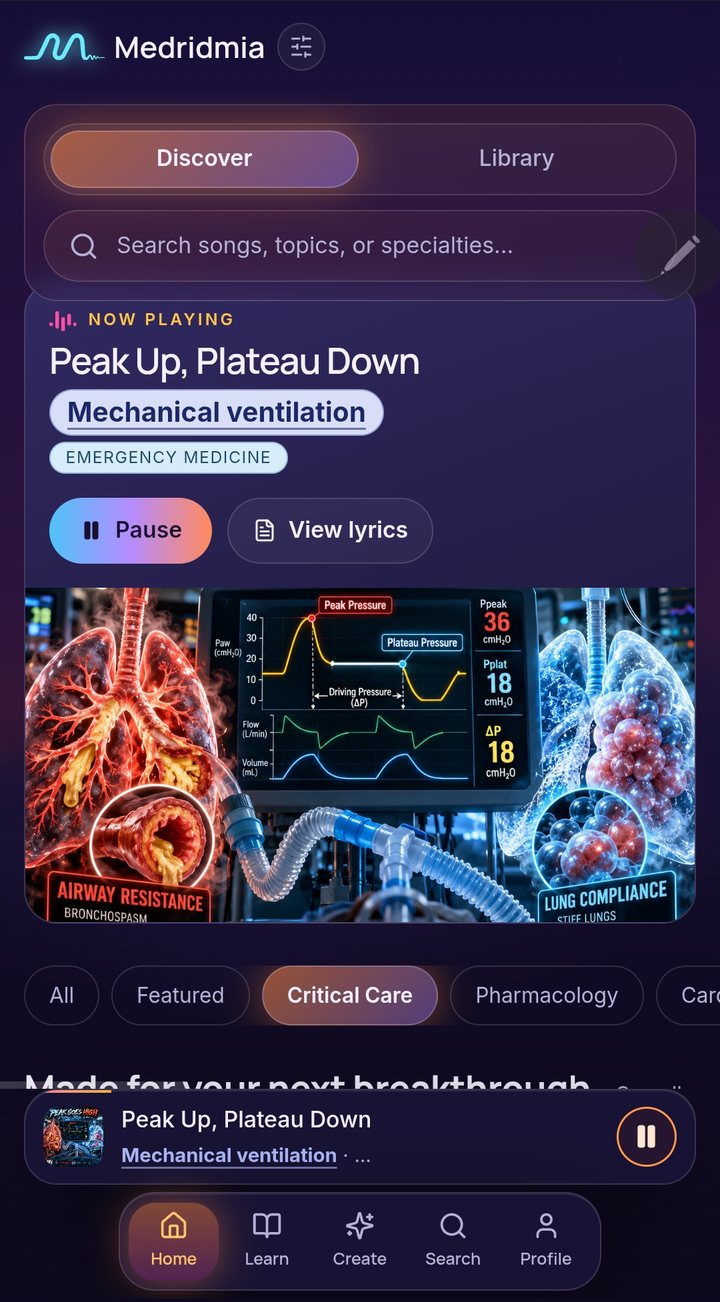
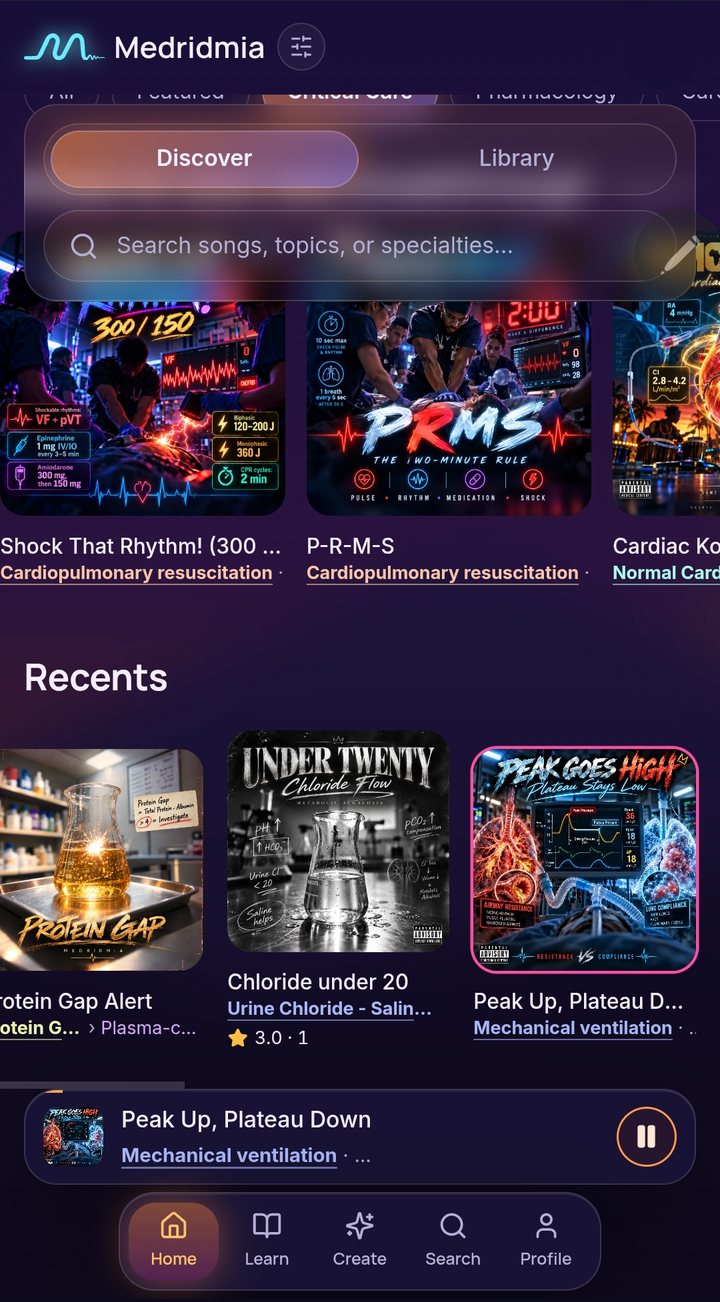
Real album art, real genres, a Recents row and subject chips. Every cover is a mnemonic in itself: the shock doses on the defibrillator, the two-minute rule spelled P-R-M-S, the chloride in the beaker.
Featured picks from the team, then a mix that follows your exam
Filter by subject with one tap
Recents keeps your last few songs one tap away
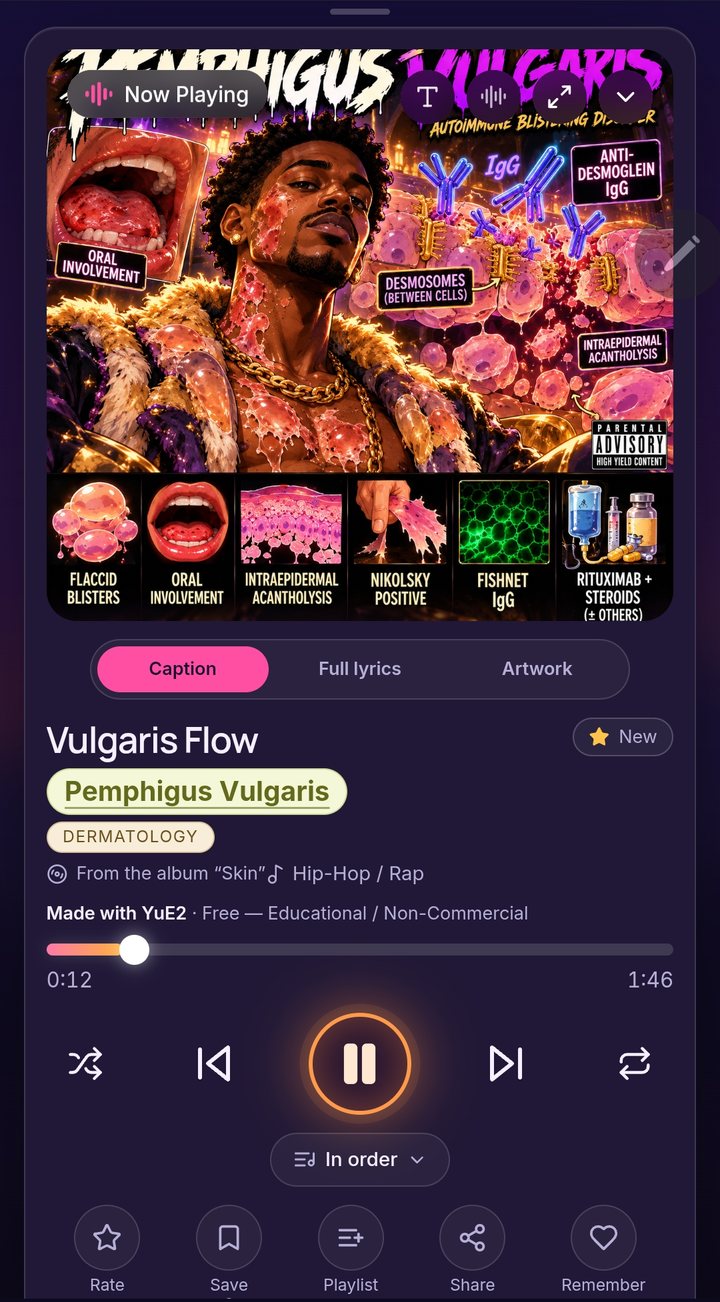
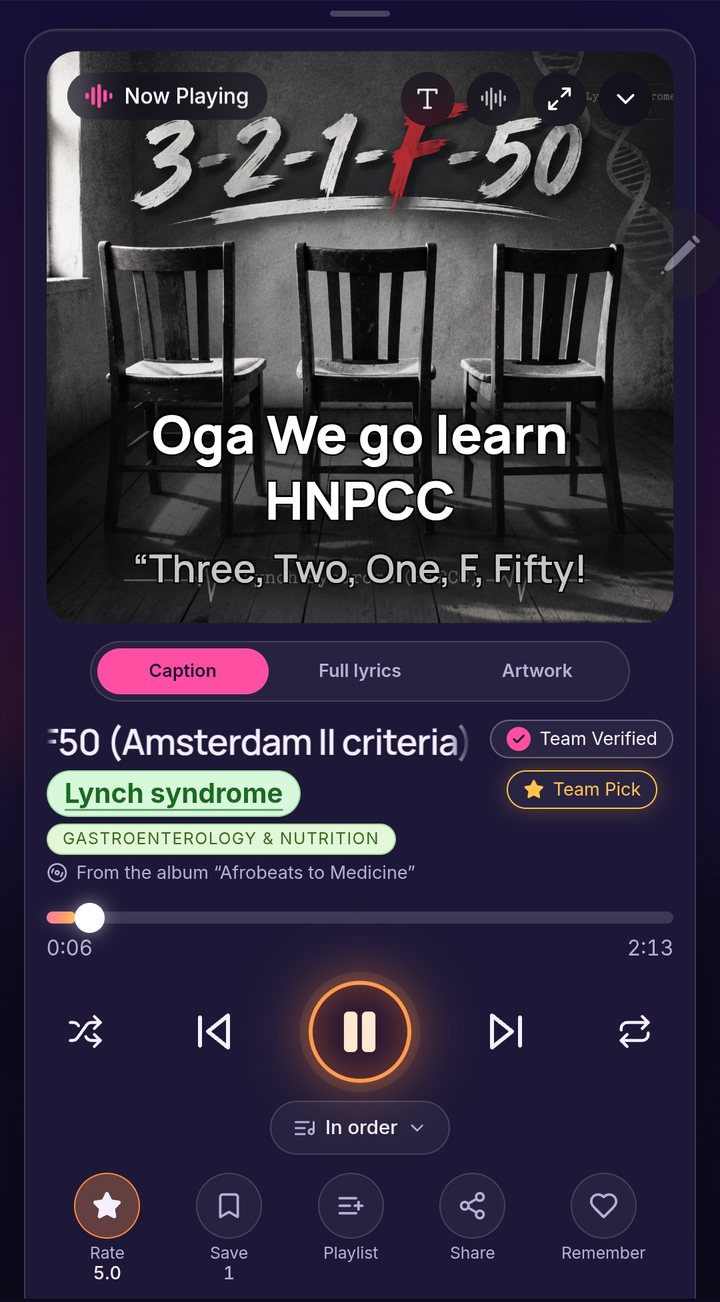
Lyrics that follow the beat
Follow synchronized lyrics as the music plays. See how each mnemonic connects to the concept, then go deeper whenever you're ready.
Become the creator
Have a mnemonic that only makes sense in your head?
Turn your own study material into music. Choose a genre, work with AI-assisted creation tools, and refine the lyrics until they're yours.
From Afrobeats and amapiano to hip-hop and gospel, your medical education can sound like you.
Create a song
Step 1 of 3 · Brief
Paste the material you want to remember. Beta-blockers: mechanism, indications, the big contraindications…
AfrobeatsAmapianoHip-hopGospel
Generate · about a minute
A medical music library
Discover songs covering clinical concepts across specialties and subjects. Explore different genres, save your favorites, and build playlists around what you're learning.
AfrobeatsAmapianoHip-hopGospelDancehall
Peak Up, Plateau DownNow playing · Mechanical ventilation
Shock That Rhythm!Cardiopulmonary resuscitation
Chloride under 20Metabolic alkalosis
Review that follows your memory
Quick recall questions and spaced repetition help you revisit material over time.
The music makes it enjoyable to return. The practice helps you find out what you actually know.
Peak pressure up, plateau normal. Where's the problem?
We believe learning can be entertaining without being careless.
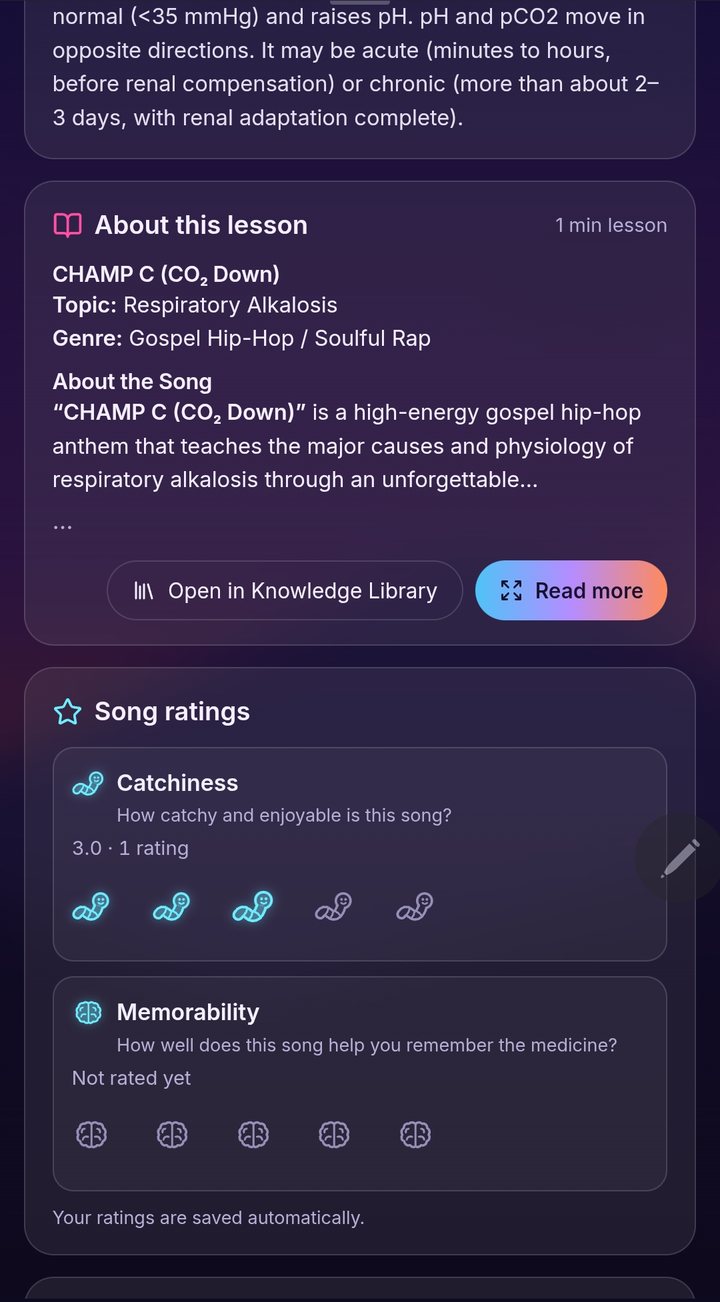
Every Medridmia song connects to an underlying medical concept, so you can go beyond the lyrics and examine the information being taught.
Songs have distinct review statuses. Listener ratings measure how catchy or memorable a track feels, not whether its medical content has been clinically validated.
Enjoy the music. Understand the medicine.
1–5
Community Rated
Feedback from learners on catchiness and memorability.
✓
Team Verified
Checked by the Medridmia team against the associated concept material.
✓
Clinician Reviewed
Additional review by a qualified clinician, identified by its review status.
Medridmia supports medical education. It doesn't replace textbooks, clinical guidelines, practice questions, or professional judgment.
Why Medridmia
Medicine is hard.
Your study tools don't have to make it harder.
You already spend hours reading, reviewing, and testing yourself.
Medridmia gives you another way to engage with the same complex information—through music you actually want to hear again.
Whether you're learning a pathway for the first time or revisiting a concept before an exam, there's room for a different approach.
We're not replacing the way you study. We're adding a soundtrack to it.
Plans
Start free. Find your rhythm.
Free
Discover mnemonic music, explore the medical Knowledge Library, and start building your own collection of study tracks.